• home
  • Bio
  • Core Values
  • News Articles
  • Testimonials
  • Blog
  • Impaired Driving
  • Immediate Roadside Prohibition
  • Domestic Assault
  • Drug Charges
  • Bail Hearing
  • Legal Aid
  • FAQs
  • Steinbach
  • Contact
Menu

Michael Dyck | Criminal Law

Rees Dyck Rogala
Law Offices
(204) 318-6116

Michael Dyck | Criminal Law

  • home
  • about
    • Bio
    • Core Values
    • News Articles
    • Testimonials
  • Blog
  • info
    • Impaired Driving
    • Immediate Roadside Prohibition
    • Domestic Assault
    • Drug Charges
    • Bail Hearing
    • Legal Aid
    • FAQs
  • Steinbach
  • Contact

Unreasonable Delay Results In DUI Acquittal

June 12, 2015 Michael Dyck
Michael Dyck criminal defence dui

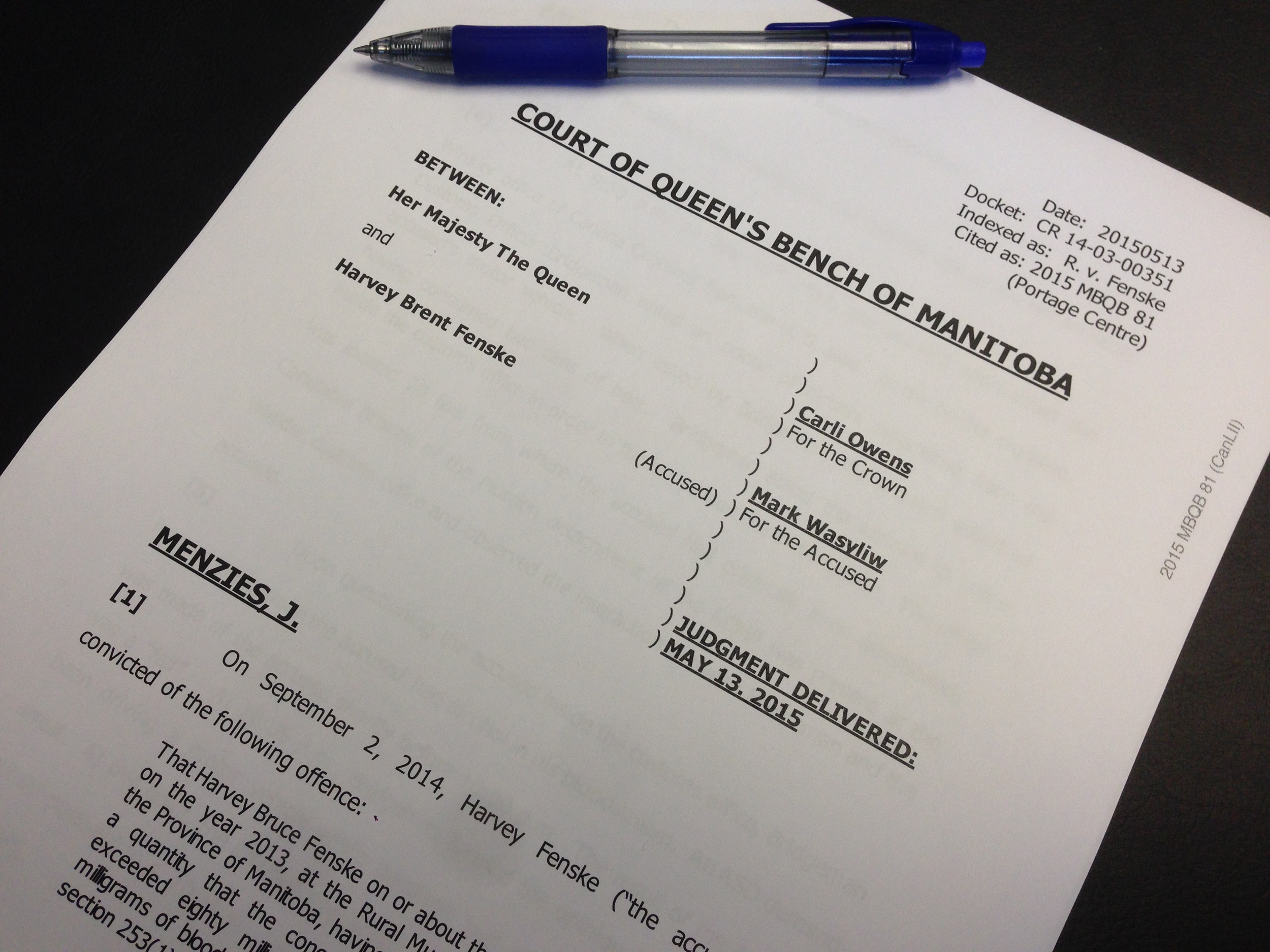
There was a recent decision from the Court of Queen's Bench, R. v. Fenske, 2015 MBQB 81. It was an appeal by the accused, Harvey Fenske, of a conviction for operating a motor vehicle with his blood alcohol level over the legal limit.

The basic facts are that Mr. Fenske was driving through the Winkler office of Canada Customs coming from the United States. The border officer noted an odour of alcohol from the vehicle and Mr. Fenske admitted to drinking two beers. The border officer asked him to exit his vehicle and he was brought inside. The border officer made a demand that Mr. Fenske provide a sample of his breath into a portable breath machine, called an Approved Screening Device (ASD) and Mr. Fenske failed the test. (Please note, there is a larger machine at police detachments that I will call a breathalyzer machine - this machine gives exact measurements of your blood alcohol level but it is not portable.) He was then arrested for driving while impaired. A constable with the RCMP was at the border office and took custody of Mr. Fenske. They drove to the Carmen RCMP detachment even though there were closer police stations in both Winkler and Morden. Mr. Fenske argued this resulted in an unreasonable delay.

After a police officer demands that you provide a sample of your breath for testing in a breathalyzer machine, the Criminal Code says the sample must be taken "as soon as practicable." What this means it that the sample should within a reasonably prompt time and a judge is supposed to consider if the police acted reasonably and expeditiously in all the circumstances in trying to obtain a sample. Another case from Manitoba, R. v. McCorriston, 2009 MBQB 7, said that as soon as practicable means, "The Crown does not have to explain every minute of the delay. However, the failure to provide a reasonable explanation for a significant delay or a portion of that delay is a factor when determining whether the delay was reasonable" (at paragraph 28).

For Mr. Fenske's case, the judge wrote in his decision at paragraph 24, "It is for the Crown to present any evidence to show the tests were administered as soon as practicable. If there was a delay, the Crown must explain why the delay was reasonable and justified in all the circumstances." Ultimately, the court held the delay in this case was not explained, it was unreasonable, and the sample was not taken as soon as practicable. Because of that, the court excluded the breath sample results as evidence and entered an acquittal for Mr. Fenske.

It is important that police officers follow the laws and the legal tests in the Criminal Code, just as it is important for individuals to follow the laws. It is my role as a defence lawyer to ensure that the police officers investigated the case appropriately and by the book. I do not think it would be fair for the police to break the rules or to cut corners to gather evidence. If that means, in some cases, a person can walk away with an acquittal even though they blew over the legal limit, I think that is the correct result.

Related articles

  • Drive impaired related offences (MichaelDyck.ca)
  • Trying to Beat the Breathalyzer Test (MichaelDyck.ca)
  • Steinbach Man Sleeping in Car a Criminal? (MichaelDyck.ca)
  • Are you guilty? (MichaelDyck.ca)
  • What is the sentencing range for an impaired driving conviction (TomRees.ca)
  • Common questions about driving impaired charges and DUIs (TomRees.ca)
  • What does "care and control" mean in drive impaired cases (TomRees.ca)

About the author

Michael Dyck is a partner at Rees & Dyck Criminal Defence. He represents clients primarily from Winnipeg, Steinbach, and rural Manitoba. He has extensive experience helping people charged with criminal offences and focuses on building legal strategy with clients. To read more of his articles, please visit his partner's website TomRees.ca.

Tags R. v. Fenske, R. v. McCorriston, driving laws, drive impaired, drunk driving, criminal law, impaired driving law, ASD, approved screening device, criminal defence, drive over .08, as soon as practicable
Comment

New Tougher Driving Laws for Manitoba

June 6, 2015 Michael Dyck
Michael Dyck criminal defence Manitoba

I recently wrote an article about Cell Phones and Driving in Manitoba and already I need to update the information. The Province of Manitoba just announced new consequences for distracted drivers, which includes using cell phones, and impaired drivers. Take note, because starting on July 1st, the new consequences come into effect.

Right now if the police catch you using a cell phone (and remember, just looking at the devices screen counts as using it), you face a $200 fine and 2 demerits. The new law will see you face 5 demerits. You can typically only earn 1 merit per year of good driving, so checking a text message or answering one phone call would result in you paying the consequences for the next 5 years. If you want to see what the actual costs are for you licence, you can check out MPI's Driver Safety Scale by clicking here.

Overall, I'm not sure if increasing the consequences will have the intended effect. I think there is still a problem where many people think it is okay to check a quick text message, reply to an email, or answer a call while in their cars. If you break it down, it is really a trained behaviour. How many times have you checked your phone with absolutely no negative consequences? Probably quite a few, if not all of them. The problem remains that it takes only one time to strike another car or a pedestrian, which can result in horrific consequences. I am curious to see if there are ways we could set up natural consequences of using your phone while driving that would happen more regularly, instead of only when the police pull you over and give you a ticket. If you have any ideas, please add a comment below.

Another change to driving laws is that it will now be MANDATORY for drivers convicted of an impaired driving related offence (like impaired driving, driving over 80, or refusing to provide a sample) to participate in the Ignition Interlock Program. Click here if you want to read the brochure. If you're convicted for a drive impaired offence, the judge will sentence you a driving prohibition where it is a criminal offence if you drive in that time period. After the judge's prohibition ends, you still need to get a valid licence from the Motor Vehicles Branch - which is Manitoba Public Insurance (MPI) here in Manitoba.

Currently, you can either wait an additional year OR register for the Ignition Interlock Program. Basically, you have to install a breath machine in your vehicle so that it will not start unless you blow a clean breath sample. The cost of the program is an estimated $2,100 per year. The new law is eliminating that choice and starting July 1st MPI will only give you a valid licence if you register for the program. In other words, you can no longer just wait it out.

Personally, I think the consequences for impaired driving are pretty serious. The problem is that most people don't know what they are. I think the general public knows it is wrong and illegal to drink and drive, but most have no clue what can happen to them if they do. That's why I think increasing penalties to try and change behaviour is not always the most effective. What would be effective is to increase the public's awareness about the consequences they could face in addition to increasing roadside check stops and publicly advertising how the police are on the lookout for impaired drivers. My idea is based on what scientific research has been able to tell us. Studies in the United states compared states that had severe consequences to ones that had less severe consequences for impaired driving. The study revealed that increasing the severity of penalties for drunk driving is not related, by itself, to lower alcohol-related motor vehicle fatalities. However, increasing the certainty of being caught for drunk driving, by utilizing check stops and testing all drivers, is associated with lower alcohol-related accidents (Evans, Neville, & Graham, 1991; Stuster & Blowers, 1995; Voas, Holder, & Gruenewald, 1999). It is really the increase in the certainty of being caught that changes our behaviour.

Related articles

  • Drive impaired related offences (MichaelDyck.ca)
  • What is the ignition interlock program (TomRees.ca)
  • Common questions about driving impaired charges and DUIs (TomRees.ca)

About the author

Michael Dyck is a partner at Rees & Dyck Criminal Defence. He represents clients primarily from Winnipeg, Steinbach, and rural Manitoba. He has extensive experience helping people charged with criminal offences and focuses on building legal strategy with clients. To read more of his articles, please visit his partner's website TomRees.ca.


Tags drive impaired, Manitoba Public Insurance, criminal law, cell phone, driving laws, demerits, impaired driving law, Ignition Interlock Program, criminal defence, drunk driving, DUI, Hand-held electronic device, Highway Traffic Act, smart phone
Comment

Supreme Court of Canada Series: R. v. St-Cloud (Tertiary Ground for Bail)

May 16, 2015 Michael Dyck
Michael Dyck criminal lawyer

On May 15, 2015, the Supreme Court of Canada released its decision R. v. St-Cloud.  This is the first of a three part series studying and outlining the case.  The court was analyzing the reasons to justify someone's detention in custody, specifically the third reason listed in the Criminal Code.  It is commonly referred to as the tertiary ground and it is found in s. 515(10)(c):  "if the detention is necessary to maintain confidence in the administration of justice, having regard to all the circumstances, including

  1. the apparent strength of the prosecution’s case,
  2. the gravity of the offence,
  3. the circumstances surrounding the commission of the offence, including whether a firearm was used, and
  4. the fact that the accused is liable, on conviction, for a potentially lengthy term of imprisonment or, in the case of an offence that involves, or whose subject-matter is, a firearm, a minimum punishment of imprisonment for a term of three years or more."

The Supreme Court considered the tertiary ground in the 2002 decision R. v. Hall, and it refers to that earlier decision throughout this one.  The Supreme Court reminded us that the Charter of Rights and Freedoms guarantees us all the right to "not be denied reasonable bail without just cause."  This court held this means two things:  "(1) the right to “reasonable bail” in terms of quantum of any monetary component and any other conditions that might be imposed; and (2) the right not to be denied bail without “just cause" at paragraph 27.

The court also clarified that in order for the tertiary ground to be relied upon, the crime does not have to be horrific, heinous, or unexplained. Justice Wagner held, "In my view, the question whether a crime is “unexplainable” or “unexplained” is not a criterion that should guide justices in their analysis under s. 515(10) (c)" at paragraph 47. Also, the rarity of a certain crime is not something to consider because the court held "I am of the view that a “rareness” of circumstances criterion would be vague and unmanageable in practice" at paragraph 52.

Finally, the court interpreted "all of the circumstances" to potentially include other aspects besides the ones listed in the Criminal Code. It is not an exhaustive list, but the court did list the following at paragraph 71:

  • the personal circumstances of the accused (age, criminal record, physical or mental condition, membership in a criminal organization, etc.) may also be relevant
  • the status of the victim and the impact on society of a crime committed against that person
  • the fact that the trial of the accused will be held at a much later date.

Overall, it seems like the Supreme Court is trying to open the door for judges to rely upon the tertiary ground in more cases. That may have been the original intent of Parliament when the legislation was enacted, but the way judges in provincial and superior courts have interpreted the law over time may have slowly changed how we thought the tertiary ground was supposed to work. It was obviously an issue important enough that the court heard the case in the first place. We now have to wait and see how it has an impact on a day to day basis when we apply for a client's release from custody.

Related articles

  • Supreme Court of Canada Series: R. v. Nur (Mandatory Minimums for Firearms) (Michael Dyck.ca)
  • How a bail hearing works in Manitoba (MichaelDyck.ca)
  • What is an undertaking? (TomRees.ca)
  • Ontario Court of Appeal revokes bail after contact breach (TomRees.ca)
  • Michael Sona is released on bail pending appeal (TomRees.ca)
  • About bail (TomRees.ca)

About the author

Michael Dyck is a partner at Rees & Dyck Criminal Defence. He represents clients primarily from Winnipeg, Steinbach, and rural Manitoba. He has extensive experience helping people charged with criminal offences and focuses on building legal strategy with clients. To read more of his articles, please visit his partner's website TomRees.ca.
Tags Supreme Court of Canada, R. v. St-Cloud, R. v. Hall, case study, criminal law, criminal defence, judicial interim release, bail application, tertiary ground, SCC
Comment

Memories Don't Just Fade Over Time

May 10, 2015 Michael Dyck
Michael Dyck criminal law

It's funny, as I was starting this article, I had Bob Seger's Night Moves playing and the lyrics "I remember, I remember, I remember, I remember" at the end of the song seemed ominously fitting. 

I came across a fascinating article this week online.  Northwestern University posted it back in 2012, so there may be newer research that exists now.  The article is called "Your Memory is Like the Telephone Game: Each time you recall an event, your brain distorts it" and you can read the full article here. The article summarizes a study published in the Journal of Nueroscience.

Basically, the researchers found that when you remember an event, the connections in your brain change in ways that can result in you remembering the event differently the next time. In the study, the lead author Donna Bridge wrote: "Your memory of an event can grow less precise even to the point of being totally false with each retrieval."

As a criminal defence lawyer, I can appreciate that by the time a witness attends court to testify, he or she may have recalled the event dozens of time. When something interesting or tramautic happens, most of us tell our friends or family about what happened. Partly, it is how we cope with things that happen to us but we also just really like telling stories. Each time you tell the story of what happened, you are retrieving that memory. For complainants, witnesses, and victims, they have to remember and tell what happened many times. First, to the police, and then to the Crown Attorney or Victim Services, and then to a preliminary hearing judge, and then to a trial judge. Nevermind all the times they share their story with their friends or family.

"Maybe a witness remembers something fairly accurately the first time because his memories aren’t that distorted,” [Donna Bridge] said. “After that it keeps going downhill.”

Bridge concluded that human memories are always adapting and that remembering an event in a new environment or in a different mood can cause the memory to integrate that new information. To me, it seems like this research is telling us that each time you remember an event it is like photocopying the last photocopy. The more times you recall the event, the less accurate it becomes - even more so if the environment you are in while recalling the memory or you mood is different. In a courtroom, a witness testifying may be nervous but he or she was likely concerned or even scared when they witnessed or experienced an incident. 

What I think we can learn from this is to try and verify what witnesses testify to as much as possible and be skeptical sometimes of what a witness thinks they remember while testifying. 

About the author

Michael Dyck is a partner at Rees & Dyck Criminal Defence. He represents clients primarily from Winnipeg, Steinbach, and rural Manitoba. He has extensive experience helping people charged with criminal offences and focuses on building legal strategy with clients. To read more of his articles, please visit his partner's website TomRees.ca.

Tags Donna Bridge, testimony, testifying, witness, memory, criminal law, criminal defence
Comment

Cell Phones and Driving in Manitoba

May 3, 2015 Michael Dyck
cell phone driving Manitoba

Update

This blog post outlines the basics for cell phone use and driving in Manitoba. But, the penalties have increased since I first wrote this post in 2015. It is a good idea to review the two update posts as well.

  • Cell Phones and Driving in Manitoba (June 2016 Update)
  • Cell Phones and Driving in Manitoba (August 2018 Update)

SteinbachOnline had a great article recently about the Steinbach RCMP actively looking for drivers who are using their cell phones while driving. Check out the full article here, Steinbach RCMP Nab Texters. Forty people were given tickets for $203.80 and drivers also face 2 demerits as well. Some people thought it was okay to talk on their cell phone if they used speaker phone and others thought it was okay to text while waiting at a red light.

In order to help clarify what you can and cannot do with a cell phone while driving, the best thing is to turn to the laws under the Highway Traffic Act here in Manitoba. Section 215.1 is the where the offence is defined and outlined.

A "hand-operated electronic device" is defined to include:

  • cellular telephone
  • another electronic device that includes a telephone function and is normally held in a hand or needs a hand to operate the device
  • an electronic device that can send or receive email or text-based messages and is normally held in a hand or needs a hand to operate the device (e.g. an iPod touch)
  • any other device listed in the regulations of the act

The word "use" is defined to include:

  • holding the device in a position in which it may be used
  • operating any of the device's functions
  • communicating by means of the device with another person or another device
  • looking at the device's display
  • any other actions listed in the regulations of the act

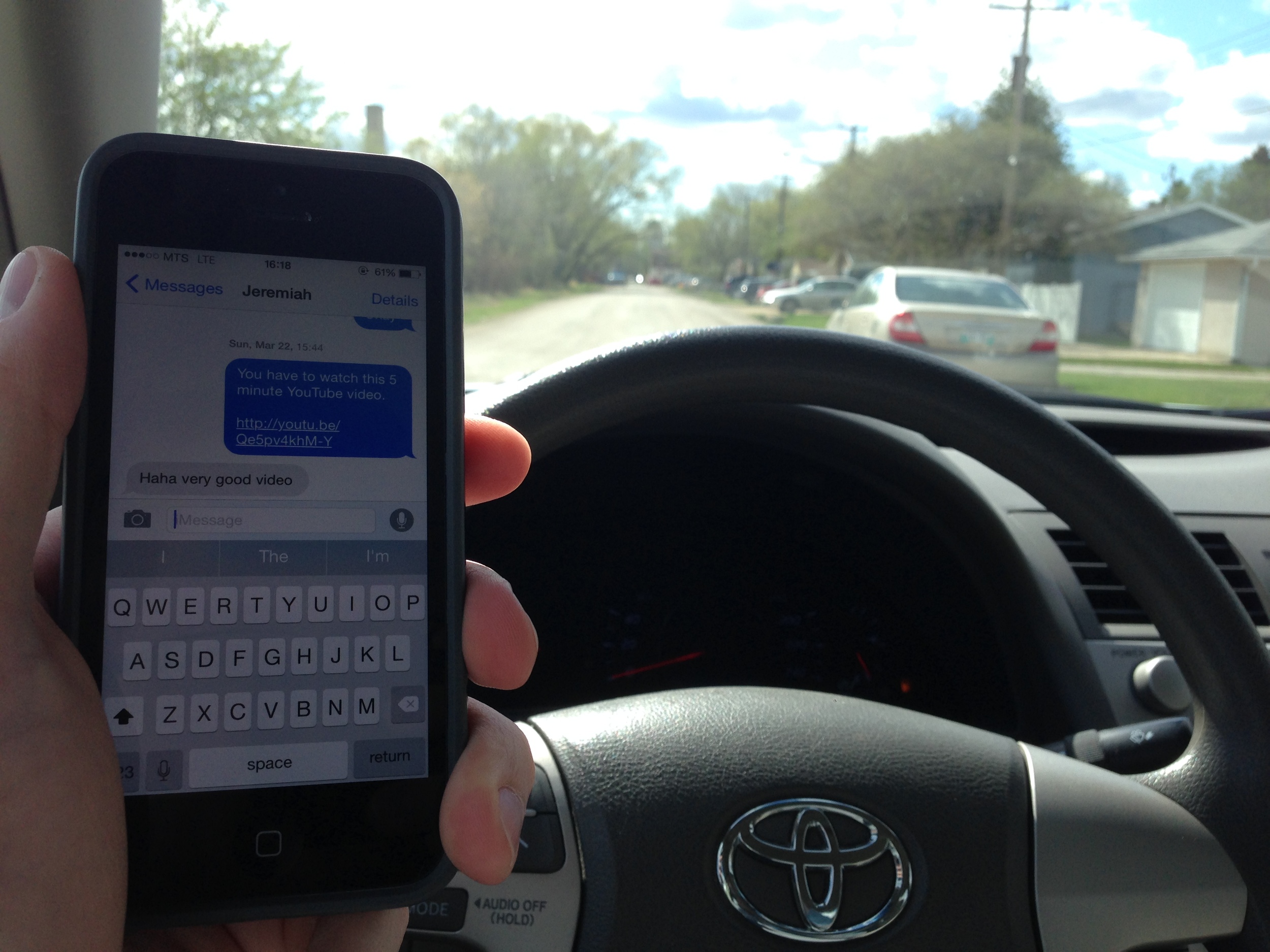
So, to be clear, even if you glance down at your iPhone that is sitting in the cupholder of your car to check the time or preview a message, you are "using" the device and breaking the law. If you use your phone to play music in your car and you switch songs using the phone, you are "using" the device. If you mount your cell phone on the dash of your car, you are "using" the device every time you look at the screen of your phone, whether the phone's screen is actually on or not. You don't have to be holding the phone in your hand to be guilty of the offence, you simply have to be using it in one of the ways the law descibes above.

The law says you are NOT allowed to use a hand-operated electronic device while driving a vehicle on a highway UNLESS:

  1. before using the device, you safely drive your vehicle OFF THE ROADWAY and then keep the vehicle stationary while using the device, or
  2. the device is set up to allow hands-free use as a telephone and it is used in a hands-free manner (this is why using a Bluetooth headset is still legal or a built in phone system in your vehicle)
  3. you are using a hand-operated electronic device with your hand to call or send a message to a police force, fire department or ambulance service about AN EMERGENCY (so you're allowed to make calls to 911 for emergency situations while driving)

So, now you hopefully know more about what you can and what you cannot do with a mobile phone in your car in Manitoba. If a fine and demerits aren't enough to encouarge you to follow the rules, using a phone while driving draws your attention away from the road and can lead to motor vehicle accidents. If you are texting before an accident and someone is injured or killed, you would likely be facing criminal charges and maybe even a jail sentence.

My advice is to buy a good Bluetooth headset to take phone calls and then leave your cellphone in a back seat or the trunk so it is out of reach and temptation.

Related articles

  • Cell Phones and Driving in Manitoba (August 2018 Update) (michaeldyck.ca)
  • Cell Phones and Driving in Manitoba (June 2016 Update) (michaeldyck.ca)
  • How much does it cost if you get a DUI? (And why it is cheaper to hire a helicopter) (michaeldyck.ca)
  • Can You Have Alcohol in Your Car (michaeldyck.ca)
  • Preventing a Break and Enter in Your Home: Tips From a Criminal Defence Lawyer (michaeldyck.ca)

About the author

Michael Dyck is a partner at Rees & Dyck Criminal Defence. He represents clients primarily from Winnipeg, Steinbach, and rural Manitoba. He has extensive experience helping people charged with criminal offences and focuses on building legal strategy with clients. To read more of his articles, please visit his partner's website TomRees.ca.

Tags Hand-held electronic device, cell phone, criminal law, criminal defence, Steinbach, smart phone, Highway Traffic Act
17 Comments
← Newer Posts Older Posts →

© Michael Dyck, 2012-2025.  All rights reserved.